

Principles For Life
Thousands of years ago someone named Patanjali wrote down a series of practices called Ashtanga Yoga. You can buy or download that text, The Yoga Sutras of Patanjali, pretty much anywhere.
These practices, or 'limbs', encourage physical, mental, and spiritual development and are central to many yoga traditions, particularly Ashtanga. The limbs aren’t about being perfect, they’re about staying aligned. When you live and train with integrity, discipline, and humility, everything works better.
Yeah, yeah, I know.
Whenever I hear people talk about hippy dippy stuff I get weirded out too. But here's the point - this is just another system of ethics and discipline. A lot of these concepts exist in other places like Buddhism, Gnosticism, Stoicism, Sufism, Taoism and so on. Add your -ism here.
There's insane stuff in any book that doesn't make sense or wouldn't be appropriate in our modern era. And keep in mind that all of these systems have been heavily edited with context relevant to the people of that time and place.
But the more you study across these ideas the root appears to be the same. Be a nice person, manage yourself and work hard on the responsibilities you have. It's just another way of living.
These are principles help you become a balanced, kinder, grounded person. You don't need to believe the woo-woo; it's just a good way to live.
Ethics (yamas) are moral principles that govern our behavior toward others. These are about self-regulation - what you don’t do that keeps your energy clean and your progress honest.
They include:
- Non-Violence (Ahimsa): Don’t trash yourself. Don’t trash others. Respect your body in training, your limits in recovery, and other people’s efforts. Kindness = sustainability.
- Honesty (Satya): Be real—with yourself and others. Are you showing up? Are you sandbagging your training? Are your excuses hiding your potential?
- Don't Steal (Asteya): Not just about stealing stuff. Are you taking without giving? Wasting time? Copying someone else’s path instead of walking your own?
- Energy Discipline (Brahmacharya): Control your impulses—scrolling, bingeing, burning out. This is about using your energy on purpose, not on autopilot.
- Don't Be Greedy (Aparigraha): Let go of what you don’t need. Possessions, titles, comparison. The less you cling to, the more you can move freely.
These are the habits (niyamas) for personal growth that build resilience and momentum from the inside out.
They include:
- Cleanliness (Saucha): Keep your space clean. Your routines tight. Your input (food, media, thoughts) clean. Your mind will thank you.
- Contentment (Santosha): Gratitude in progress. Appreciate the run, even if it’s slow. Enjoy the lift, even if it’s heavy. Celebrate where you are—then keep moving forward.
- Discipline (Tapas): Heat. Effort. Willpower. Tapas is showing up on the days you don’t feel like it.
- Self-Study (Svadhyaya): Pay attention. What worked? What didn’t? Journaling, reflection, reading—it all sharpens your awareness and guides growth.
- Faith (Ishvara): Do the work. Release the outcome. Trust the process. Sometimes, the most powerful move is letting go of control and showing up anyway.
On the other side of the fence we have Ray Dalio's Principles for Success, which I have found equally helpful. Here's the gist of his Life Principles.
Life Principles
#1 - Think for yourself to decide:
1) what you want,
2) what is true, and
3) what you should do to achieve #1 in light of #2. . .
#2 - Make believability-weighted decisions.
#3 - Operate by principles that are so clearly laid out that their logic can easily be assessed and you and others can see if you walk the talk.
#4 - Systemize your decision making.
#5 - Embrace Reality and Deal with It.
#6 - Use the 5-Step Process to Get What You Want Out of Life
- Have clear goals.
- Identify and don't tolerate problems.
- Diagnose problems to get at their root causes.
- Design a plan.
- Push through to completion.
#7 - Be Radically Open-Minded
#8 - Learn How to Make Decisions Effectively
Set Quarterly Goals
I make a list of goals for each quarter (every 3 months). Monthly goals felt too short but quarterly goals felt like I could determine where I wanted my energy to go long term. I get these goals down to a page and organize it by category (i.e. Fitness, Finance, Social). I print out a few copies and stick them all over the house. At the end of each quarter I look back on how I did. The process begins again.
Typically I build on goals from the previous quarter. If I didn't accomplish anything useful, I'll reflect on why and adapt. This is the core of what I learned from Principles - it truly is OK if your way of doing things is different - just make sure it actually works for you.
Keep a Daily To-Do List
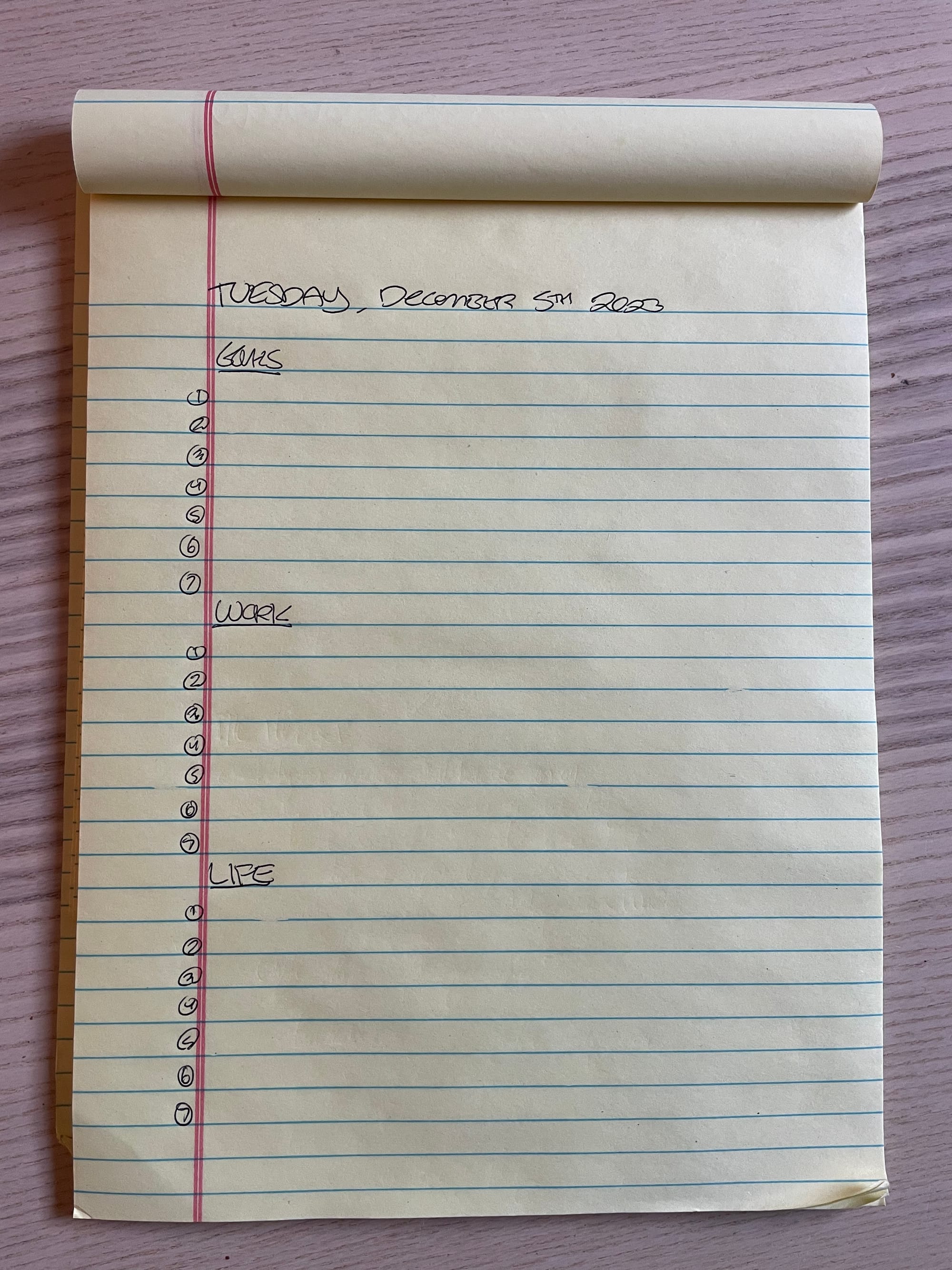
Every day I write a to-do list, which is broken up between my quarterly goals, work tasks, and general life tasks (i.e. laundry, doctor's appt.).
I wake up in the morning, do a clear-headed meditation then write down my objectives. When I wander mentally throughout the day I refer back to this list - if I can complete at least one more task, that gives me enough momentum and confidence to keep going.
Keep a Daily Routine
Here's what I try to accomplish every day. My unbreakable commitment is my Morning Ritual and I've stuck to that for the last seven years. Ideally I'm doing pushups and additional meditations but every day is different. but no matter what, where I am, I can commit to breathing exercises, meditation, some stretching and make a plan for the day. On the weekends that plan is usually in my head but I try to map out my objectives.
Morning Ritual
- Ideally wake up between 6:30am and 7:30am
- 3 rounds of breathwork (WHM)
- 15+ minutes of meditation
- after meditation I sit for a couple extra minutes to think through what i'm grateful for: family, friends and all that life has given me and send good vibes out to all beings everywhere. this is honestly a new thing for me but it feels natural and right.
- 5 days a week: 15+ minutes of yoga asanas
- Make daily to-do list
Throughout The Day
- Read book of choice for ~30 minutes
- Get a workout in if possible: typically I follow a training program to keep me on track. An easy one for me is yoga, or at the very least, 30 minutes of walking. If I'm trapped somewhere physically - 50 pushups: 5 sets of 10.
- Journal: My daily journaling is what became Sendō. These days I'll write every few days after a workout or major update to record any insights and feelings. It's great to journal to get your feelings out from each day. you may not look back on it but you're expressing your feelings to the void which helps process things.
- Midday meditation: 5+ minutes
- EOD meditation: 5+ minute meditation after work/towards bedtime
 Sendō
Sendō
Foundations
 Sendō
Sendō
 Sendō
Sendō
 Sendō
Sendō
 Sendō
Sendō
 Sendō
Sendō
Applications
 Sendō
Sendō
 Sendō
Sendō
 Sendō
Sendō

Subscribe to get updates on new content, merch and more from Sendō Worldwide.
Browse the Online Shop for apparel, accessories and training books to equip yourself for the path ahead.
Have a tip, story, or idea? It could end up in a future post. Email me anytime with questions, thoughts, or even confessions — we're all in this together.